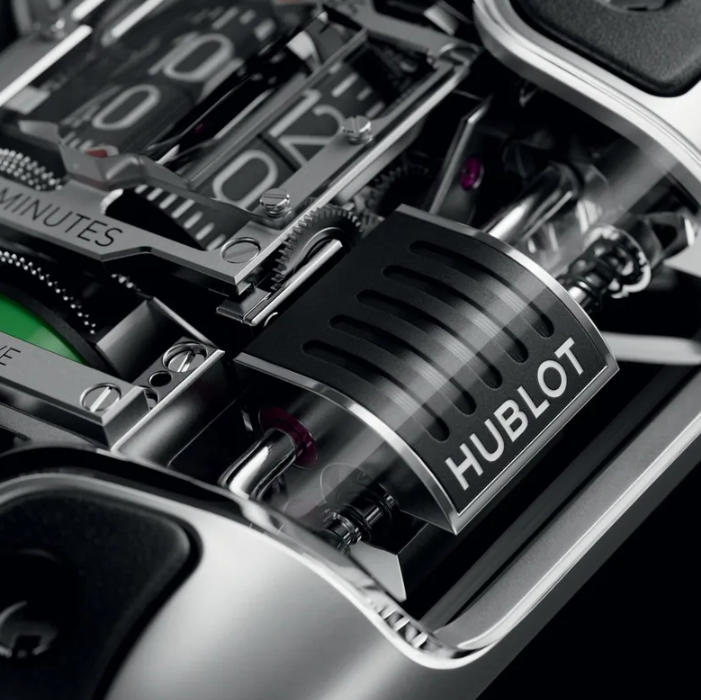
Some watches make sense the moment you see them. The Hublot MP-10 Tourbillon Weight Energy System Titanium is not one of those watches. There are no conventional hands, no familiar round dial and very little about the case that follows the usual rules of Swiss watchmaking. You have to spend a little time with the design before its logic starts to become clear. That is also what makes the MP-10 interesting. Hublot has never been particularly concerned with making watches that disappear quietly beneath a cuff, but this model goes further than the usual oversized case or unusual material. The entire watch has effectively been built around its movement, with the mechanical architecture becoming the display itself. For readers following unusual Swiss watch design through our UK replica watch coverage, the MP-10 is worth examining because so many of the features that define it are structural rather than decorative. Reproducing the general appearance is one thing; understanding why the original looks the way it does is another.
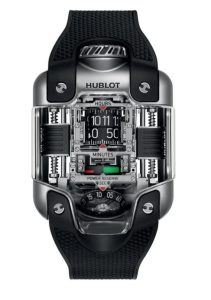
A watch that abandons the conventional dial
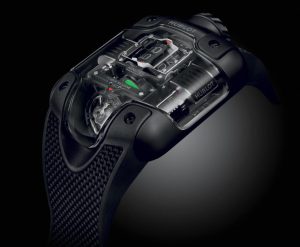
The first thing that stands out is the absence of normal hands. Instead of placing an hour hand and minute hand above a flat dial, Hublot arranges the information vertically through the centre of the watch. Hours and minutes appear on rotating anodised aluminium cylinders toward the upper section of the movement. Below them sits the power-reserve display, while the running seconds are connected visually to the tourbillon at the bottom. It sounds complicated when described on paper, yet the actual idea is fairly simple: your eye moves down the watch rather than around it. This unusual layout is one of the reasons the Hublot MP-10 Tourbillon Weight Energy System Titanium feels closer to a mechanical instrument than a conventional luxury watch. There is plenty happening inside the case, but the information has a deliberate order rather than appearing randomly across an openworked movement.
The proportions make more sense when you see the architecture
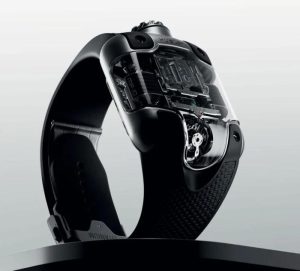
At 54.1mm long and 41.5mm wide, nobody is going to mistake the MP-10 for a restrained dress watch. Those measurements sound enormous, although width alone does not explain how the watch sits because the case follows a long, curved form rather than a traditional circular shape. The 54.1 x 41.5 mm titanium case is finished in shiny microblasted titanium. That choice matters. A watch with this much visual mass could easily become overwhelming in steel or precious metal, while titanium helps keep the construction relatively light and gives the exterior a technical finish that suits the movement underneath. The sapphire crystal is equally important to the design. Instead of being a simple flat window over the dial, it follows the complex geometry of the movement and case. From the side, the MP-10 has considerable depth, and this three-dimensional quality is arguably more important to its character than the basic case measurements suggest. Water resistance is rated at 30 metres, which tells you something about the priorities here. This is not a sports watch that happens to contain an exotic complication. The engineering effort is concentrated on the movement, display and winding system.
The movement is the real reason the MP-10 exists
Inside is the HUB9013 self-winding skeleton tourbillon movement. Hublot developed the MP-10 over a five-year period and the completed calibre contains 592 components, which gives some idea of how far removed the construction is from an ordinary automatic movement. The tourbillon sits toward the lower part of the watch and is inclined at 35 degrees. Visually, it provides a natural endpoint to the vertical display. Your eye starts with the hours and minutes at the top, passes the power reserve in the centre and finishes at the moving tourbillon below. That arrangement feels far more coherent than simply cutting away a conventional dial to expose the gears beneath it. The mechanism has been designed to be seen from the beginning. The result is one of those rare openworked watches where the absence of a traditional dial is fundamental to the design rather than an aesthetic afterthought.
Two moving weights instead of a conventional rotor
The most interesting feature, however, is hidden in plain sight. Most automatic mechanical watches use a semicircular rotor that rotates around a central bearing as the wrist moves. That approach would have conflicted with the architecture Hublot wanted for the MP-10, so the company developed an entirely different arrangement. On either side of the movement are two linear winding weights. These white-gold masses move vertically rather than rotating around the back of the calibre. Their movement engages a rack mechanism that winds the mainspring in both directions. It is a wonderfully mechanical solution because you can understand the basic principle simply by watching it work. Instead of hiding the automatic winding system behind the movement, Hublot turns it into part of the spectacle. The HUB9013 provides approximately 48 hours of power reserve. The watch can also be wound through the crown positioned at 12 o’clock, while time setting is handled separately from the rear of the case. That unusual arrangement allows the sides of the case to remain visually clean.
Does it actually work as a watch?
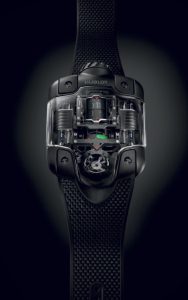
This is where opinions will divide. If your idea of good watch design begins with instant legibility and familiar proportions, the MP-10 will probably feel unnecessarily complicated. You have to learn where to look, and there is no pretending that a case more than 54mm long is discreet. But judging the MP-10 by the standards of a simple three-hand watch rather misses the point. What Hublot has done well is make the complication determine the shape of the watch. The unusual case is not there simply because someone wanted something futuristic. Its proportions follow the vertical calibre, the winding system sits on either side of that architecture and the time display follows the same top-to-bottom direction. That relationship between exterior design and internal construction gives the watch a coherence that is difficult to appreciate from specifications alone.
It is unmistakably Hublot, but not in the usual way
Hublot is normally associated with the Big Bang’s visible screws, broad bezel and muscular case construction. The MP-10 approaches the brand’s familiar taste for bold design from another direction. There is still nothing subtle about it, but the visual drama comes from engineering rather than colour or surface decoration. I would not call it conventionally beautiful. In fact, some angles are awkward and the case is undeniably demanding. But that awkwardness is partly what makes the watch memorable. Plenty of expensive watches are beautifully finished versions of ideas that have existed for decades. The MP-10 at least attempts to rethink how an automatic mechanical watch can be arranged. For anyone comparing the broader world of Hublot replica watches and Hublot-inspired designs, this particular model also highlights an important distinction. The character of the MP-10 comes from the interaction between the case, display and winding mechanism, not simply from its external silhouette. That makes it considerably more complicated to understand than a watch whose identity is defined mainly by a bezel, dial colour or bracelet.
The details that matter most
Look past the dramatic appearance and a few features explain most of the MP-10’s personality: the elongated titanium case, the cylinder-based time display, the inclined tourbillon and the pair of linear automatic winding weights. Those elements work together. Remove one of them and the design starts to lose its purpose. This is why the Hublot MP-10 design and movement architecture deserves more attention than its headline dimensions. The case is large because the calibre is vertical. The dial disappears because the movement provides the display. The conventional rotor disappears because it would obstruct that architecture. Even readers who dislike the finished watch can appreciate the consistency of the thinking behind it.
Adam Green’s view
The MP-10 is probably not the Hublot I would choose for everyday wear. It is too large, too visually busy and far too specialised to pretend otherwise. But I find it more interesting than many watches that are easier to like. There is a difference between making something unusual for attention and accepting the consequences of an unusual mechanical idea. The MP-10 feels closer to the latter. Its best feature is not actually the tourbillon. For me, it is the way the linear automatic winding system becomes part of the visual identity of the watch. You can look at the movement and understand that Hublot was trying to solve a practical design problem rather than simply adding another complication to a familiar case. That does not make the MP-10 subtle, affordable or universally appealing. It does make it difficult to confuse with anything else. And in modern watchmaking, where genuinely different mechanical layouts remain relatively rare, that may be the strongest argument in its favour.